David Goldschmid
The Hanging GirlDavid Goldschmid, Alberte Goldschmid’s twin and confidant, survives in the investigation chiefly through the memories of his parents and the belongings they could not bring themselves to sort. His death from AIDS in 2004 had its own weight in the family, but the unopened contents of his old room also preserved a connection to Alberte—and, in a postcard, a possible clue to a meeting whose date could not be established.
Identity and Family Background
David was Alberte’s twin brother, though he was technically the older of the two by seven minutes. The smallness of that difference makes the distinction almost playful, but the family’s description of them is emphatic: they were exceptionally close. When Carl Mørck asked about their bond, Rachel Goldschmid raised two crossed fingers and compared them to peas in a pod. Her attempt to smile as she described David’s birth and her visible tiredness in the conversation suggest how difficult it remained for her to speak of the twins and what happened to them.
The parents’ accounts of David’s death reveal different ways of naming the family’s grief. Rachel said that he could not bear what happened to Alberte and had simply faded away. Eli Goldschmid immediately corrected her, saying that David died of AIDS, and objected to the implication that the event surrounding Alberte was the explanation. He also acknowledged that it was still hard for them to accept what David stood for. The exchange does not settle how David himself understood his sister’s fate or his illness; instead, it shows that even his parents did not tell his story in the same terms.
Leaving Home and the Unopened Room
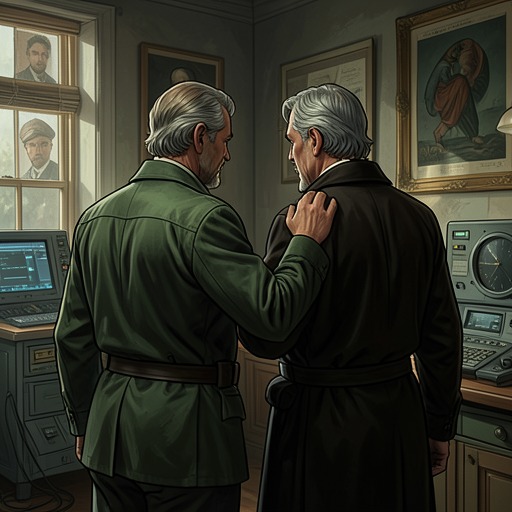
David moved out when he was eighteen and lived in Vesterbro, which Rachel described as not one of the better places. His old room at the family home remained cluttered rather than being converted into a nursery. After he died in 2004, his friend sent various belongings out to the family, who placed them in the room. Rachel and Eli never went through them: they felt unable to take on David’s possessions as well as the loss itself.
That unexamined room gives David’s absence a material form. His things were neither discarded nor carefully catalogued; they remained together because his parents could not face sorting them. As a result, a private space preserved a record that the family had not deliberately made into evidence. The room’s contents connected David’s life away from home with the history of Alberte’s disappearance and death, although the parents had not known what the stored items might reveal.
The Postcard and Alberte’s Unrecorded Meeting
Among the belongings, Carl and Assad found a postcard from Alberte addressed to David. Its informal greeting, “Hi bro,” and closing, “your sis,” echo the closeness Rachel had described. Alberte wrote that she had visited Østerlars Round Church, where she heard about the Knights Templar, but said the most memorable part of the trip was meeting an attractive man who knew more about the church than the guide. She planned to meet him outside school the following day and promised to write more later.
The postcard changes the room’s significance: David’s returned belongings contain a trace of Alberte’s life and an encounter she had shared with her twin. But the trace is incomplete. Carl turned the card over to look for a date and found none. His immediate question about when it was written marks the gap between discovery and proof: the postcard establishes that Alberte described meeting the man, but, without a date, it does not by itself place the encounter within a reliable chronology.
Narrative Role
David is not present in the investigation as an active participant; he is reconstructed through family testimony and the objects left behind. Those sources pull in different directions. Rachel presents his death as inseparable from the shock of Alberte’s fate, while Eli insists on AIDS as its cause and resists turning David into a simple consequence of his sister’s tragedy. The tension preserves both the family’s grief and the limits of what the investigators can know about it.
His importance to the case lies in this conjunction of intimacy and evidence. The twins’ closeness explains why Alberte wrote to him, while the parents’ decision to leave his room untouched allows her postcard to survive among his things. Yet the missing date withholds the certainty the investigators need. David’s posthumous presence therefore offers a lead without completing it: his room brings Alberte’s own words into the inquiry, but the unresolved timing keeps the meeting open as a question.